
Affiliate Marketing Trends 2026: What’s Actually Changing (and What to Do About It)
TL;DR: Affiliate marketing in 2026 is a $14+ billion industry that keeps growing at roughly 10% a year — but the rules of the game are shifting. AI-generated search answers are eating informational clicks, cookie-based tracking is fading in favor of server-side tracking, micro-creators are outperforming mega-influencers, and performance-based payouts now dominate. The affiliates winning in 2026 are the ones building trust-first content, owning an audience (email list, community), and adapting to AI-driven discovery instead of fighting it.
Every few years, someone declares affiliate marketing dead. In 2026, the obituary writers are pointing at AI search answers that summarize product recommendations right on the results page, at stricter privacy rules that break old tracking cookies, and at commission cuts from a few big programs. The noise is loud — but the numbers tell a different story. The affiliate marketing trends of 2026 point to an industry that is growing, professionalizing, and quietly moving money toward the partners who bring real customers.
This guide cuts through the hype with a clear-eyed look at affiliate marketing trends 2026: how AI is actually changing affiliate marketing, where the money is moving in the creator economy, how tracking and payouts are evolving, and a practical playbook for what’s working right now. No gimmicks, no “get rich overnight” nonsense — just the shifts that matter and what to do about them.
Affiliate Marketing Trends 2026 at a Glance: Changing, Not Dying
Let’s settle the big question first. Affiliate marketing is not dying in 2026. Industry estimates put the global affiliate marketing market at well over $14 billion, growing at roughly 10% per year. More than 80% of brands now run some form of affiliate or partner program, and affiliate-driven e-commerce sales keep climbing year after year.
What is dying is the old playbook: thin review sites stuffed with keywords, coupon sites that intercept shoppers who were already going to buy, and “spray and pray” link-dropping on social media. AI search and stricter tracking killed that version — and frankly, it deserved to die. What’s replacing it is more interesting: trust-first creators, server-side tracking that’s actually more accurate than cookies ever were, and brands paying for performance instead of vanity impressions.
Think of 2026 as the year affiliate marketing grew up. The barrier to entry rose, but so did the quality of the opportunity.
How Big Is Affiliate Marketing in 2026? The Numbers
Before we get into trends, let’s ground ourselves in the actual scale of the industry — because the numbers explain why the big shifts are happening.
| Metric | Figure (2026 industry estimates) | What it means for you |
|---|---|---|
| Global industry value | $14+ billion | The pie is growing; new affiliates can still get a slice |
| Annual growth rate | ~10% | Faster than most advertising channels |
| Brands with affiliate programs | 80%+ | Nearly every niche has programs to join |
| Average affiliate ROI | ~$6.50 per $1 spent | One of the highest-ROI channels for brands |
| Publishers worried about AI traffic shifts | ~69% | Real concern — adaptation is mandatory |
| AI answers citing earned media | ~84% | Authentic content gets quoted by AI systems |
These figures come from industry surveys and performance-marketing reports (Statista, the Performance Marketing Association, and affiliate platform data). Treat exact numbers as directional — the industry doesn’t publish audited per-partner data — but the direction is unambiguous: up.
The money keeps flowing because the economics are irresistible for brands. With affiliate marketing, a company pays only when a sale (or lead, or install) actually happens. Compare that to display ads or flat-fee sponsorships, where the brand pays regardless of outcome. In an economy where every marketing dollar gets scrutinized, pay-for-performance is the last budget to get cut — which is exactly why affiliates who deliver genuine customers keep getting paid.
Trend 1: AI Search Is Reshaping Where Clicks Come From
The single biggest story in affiliate marketing trends in 2026 is AI in search. Google’s AI-generated answers, Bing’s Copilot summaries, and standalone AI assistants now answer many product questions directly — “what’s the best budget microphone” gets an instant summarized answer, no click required.
What this means for affiliates
The traffic model that powered a decade of affiliate sites — rank a “best X” article, collect clicks, earn commissions — is under real pressure for purely informational queries. When an AI answer satisfies the question, fewer users click through. That’s not speculation; publishers across the industry are reporting softer click-through rates on top-of-funnel comparison content.
But here’s the part the doom-posts skip: AI systems need something to cite. Research into how AI answer engines source their answers found that earned media — independent reviews, comparisons, and expert content — makes up the large majority of what these systems quote (one widely cited 2026 study put it around 84%). In other words, the content affiliates have always produced — hands-on reviews and honest comparisons — is exactly the raw material AI search is built on.
How winning affiliates adapt
- Go deeper than AI can summarize. AI answers handle “what are the top 5 options” well. They handle “here’s what happened when I used this product for 90 days, with photos of the failure” poorly. First-hand experience is your moat.
- Build brand search demand. When people search for your site or channel by name, AI summaries can’t intercept that intent. Email lists, communities, and loyal followings are click-proof assets.
- Optimize for being cited. Clear structure, factual claims, original data, and quotable verdicts increase the odds an AI system cites your page — and citations still drive brand discovery even without a click.
- Shift toward bottom-of-funnel intent. Queries with buying intent (“buy,” “coupon,” “vs,” “review,” specific model numbers) still convert and still get clicks, because the user wants to transact, not just learn.
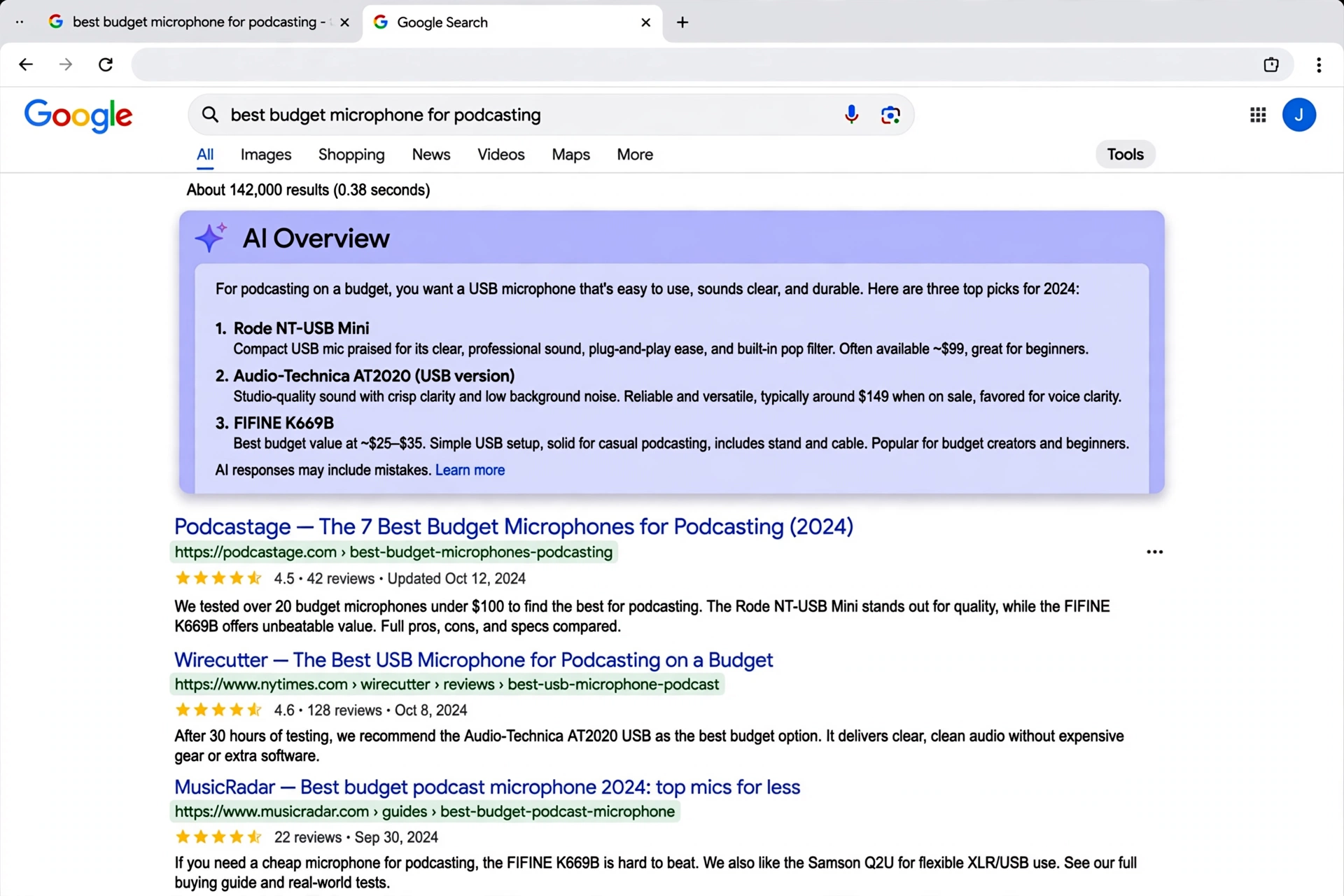
Key takeaway: AI search doesn’t kill affiliate content — it cites it. Pages with hands-on testing, original photos, and clear verdicts get quoted by AI answer engines. Generic summaries get skipped.
Trend 2: Cookie Tracking Is Fading — Server-Side Tracking Takes Over
The second major shift in affiliate marketing in 2026 is technical but crucial: third-party cookies are becoming unreliable. Browser restrictions, ad blockers, and privacy regulations like GDPR have steadily degraded cookie-based tracking. For affiliates, that used to mean lost commissions — sales you drove but never got credited for.
The industry’s answer is server-side tracking: instead of relying on a cookie in the visitor’s browser, the merchant’s server records the conversion and reports it back to the affiliate network directly (often via conversion APIs). This is more accurate, harder to block, and privacy-compliant when implemented properly.
What this means for you
- Choose networks with modern tracking. When joining a program in 2026, ask whether it uses server-side tracking or conversion APIs. Networks still running purely on cookies are living on borrowed time.
- Expect more accurate attribution. Paradoxically, the death of cookies is good for honest affiliates — fewer lost sales, cleaner data, and less credit stolen by cookie-stuffing fraud.
- First-party data matters more. Your own email list and audience data become more valuable as third-party identifiers weaken. The affiliates who own their audience are insulated from tracking chaos.
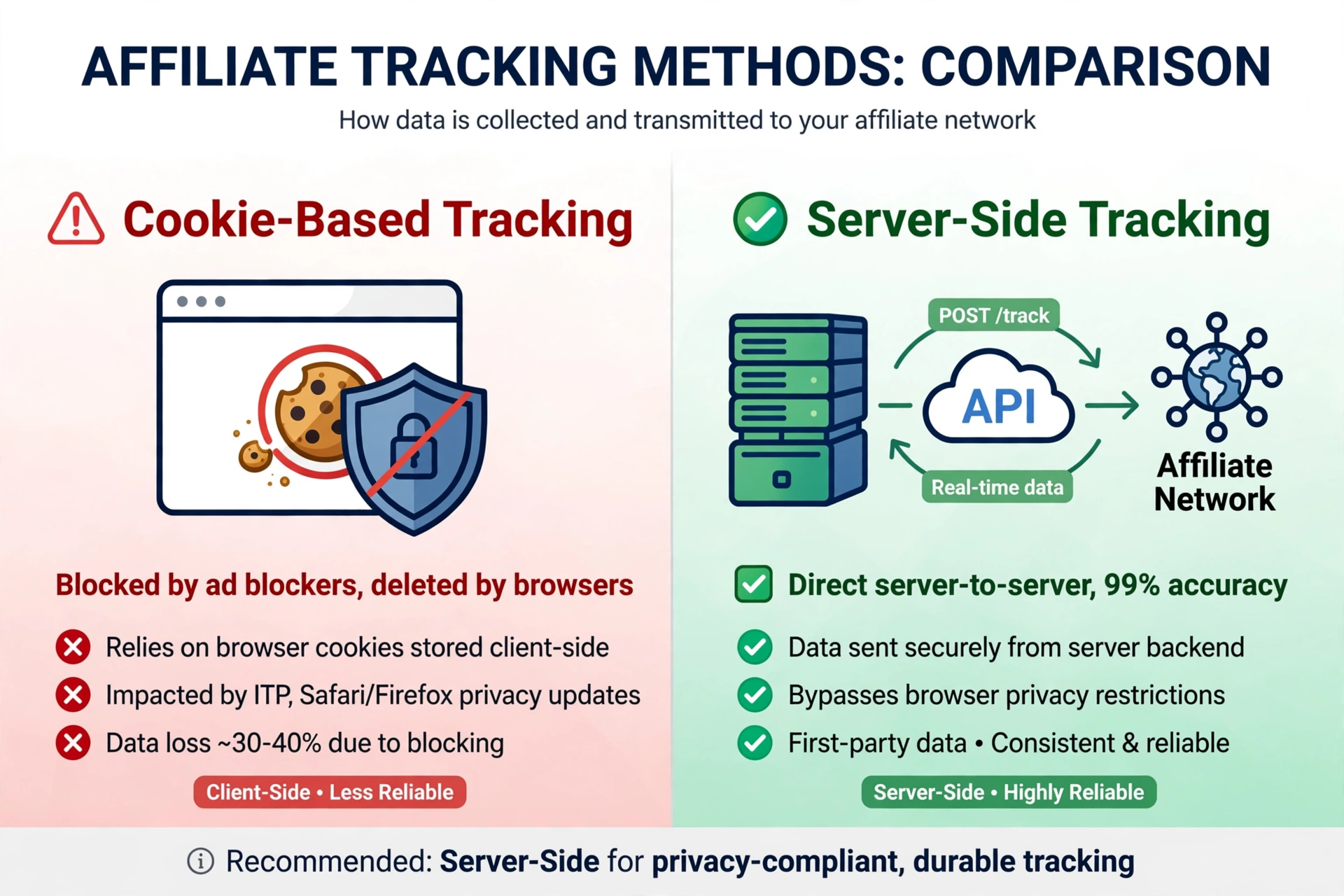
Key takeaway: Ask every program you join: “Do you use server-side tracking or conversion APIs?” If the answer is cookies-only, your commissions are leaking.
Cookie duration still matters too. A 30-day cookie window (the industry standard on most major networks) gives you a meaningful chance to earn on delayed purchases — important in niches like software, travel, and finance where buyers research before committing.
Trend 3: Micro-Creators Are Beating Mega-Influencers
One of the clearest affiliate marketing trends in 2026 is the shift in who earns. Brands are redirecting budgets away from mega-influencers with millions of passive followers and toward micro and mid-tier creators (roughly 10,000–100,000 followers) with tight, engaged, niche audiences.
The reason is simple math. A creator with 40,000 followers who genuinely uses and understands a product will often convert at several times the rate of a celebrity endorsement — because their audience trusts the recommendation. Trust is the currency of affiliate marketing, and trust scales inversely with audience size. A niche tech reviewer, a budget-travel blogger, or a home-coffee enthusiast converts followers that a generic lifestyle influencer never could.
What this means for beginners
This trend is genuinely good news if you’re starting small. You don’t need a million followers — you need a defined audience and real credibility in one lane. Some practical implications:
- Pick one niche and go deep. “I review budget audio gear for podcasters” beats “I post about tech, fitness, and travel.” Depth builds trust; trust builds conversions.
- Video and short-form win. TikTok Shop, Instagram Checkout, and YouTube Shopping have collapsed the distance between content and purchase. A 60-second honest demo can now convert directly inside the app.
- Long-term partnerships beat one-off promos. Brands in 2026 increasingly offer creators ongoing relationships — monthly retainers plus commissions — instead of single sponsored posts. If a brand approaches you for one post, pitch them a three-month partnership. It pays better and converts better because repeated exposure builds familiarity.
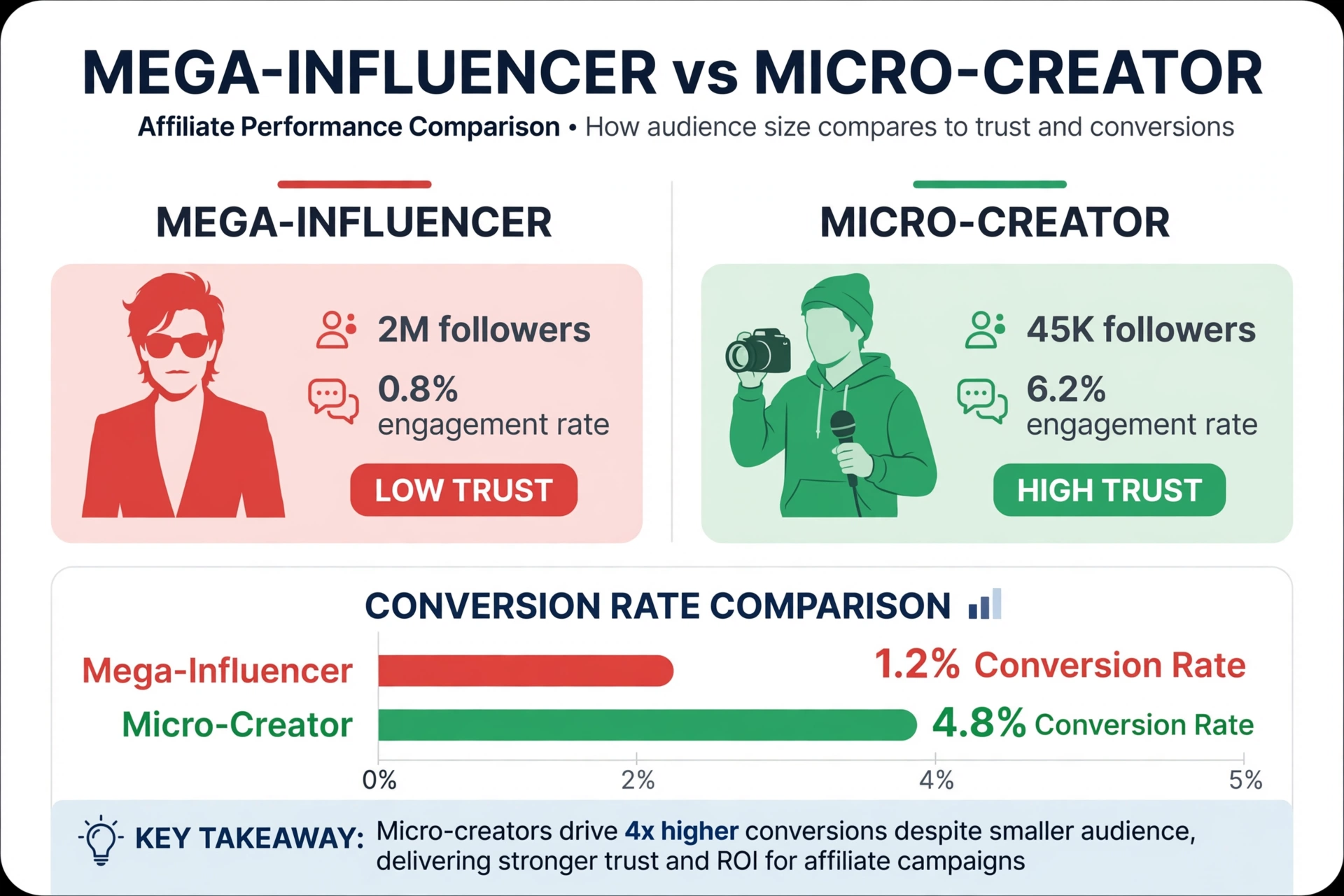
Key takeaway: You don’t need 1M followers. A defined niche + real credibility in one lane beats a massive generic audience every time.
Trend 4: Performance Models Dominate — and Flat Fees Are Coming Back in a New Form
Advertisers in 2026 are more ROI-obsessed than ever. Cost-per-acquisition (CPA) and revenue-share models continue to replace flat-fee sponsorships, because they tie spend directly to outcomes. For affiliates, this is the home turf: you only get paid when you deliver.
But there’s a twist. Because AI answer engines now generate value above the click — your content might influence a purchase without ever producing a trackable click — some brands are experimenting with hybrid models: a flat retainer for maintaining high-quality, citation-worthy content, plus a performance component on top. One common structure: the partner receives whichever is greater in a given period, so creators aren’t punished in slow-click months while brands aren’t overpaying when performance spikes.
This is still experimental, not standard. But it signals something important: brands are starting to price the influence layer of affiliate content, not just the last click. If you produce content that AI systems cite and buyers trust, your leverage in negotiations is growing.
Typical commission structures in 2026
| Program type | Typical commission | Cookie window | Best for |
|---|---|---|---|
| Software / SaaS (recurring) | 20–50% recurring | 30–90 days | Highest lifetime value per referral |
| Web hosting | $50–$150 per sale | 30–90 days | High one-time payouts |
| Amazon Associates | 1–4.5% | 24 hours | Volume + conversion rate, low rates |
| Fashion / lifestyle | 5–15% | 7–30 days | Social and content creators |
| Finance / credit cards | $50–$200+ per approval | 30 days | High payouts, strict compliance |
| Digital courses | 30–50% | 30–60 days | Education and creator niches |
| VPN / security tools | 40–100% of first sale | 30 days | Tech and privacy audiences |
The pattern: recurring-revenue software and high-ticket services pay the most per customer. Beginners often start with Amazon or a niche retailer for easy approvals, then graduate to SaaS and hosting programs as their traffic grows.
Trend 5: Trust Beats Traffic — Authenticity Is the Algorithm
Across every 2026 affiliate marketing trend report, one theme repeats: authenticity converts; hype doesn’t. Audiences have developed extremely sensitive hype-detectors. They can tell when a “review” was written without touching the product, and they punish it — with their attention and their wallets.
This is partly defensive (AI-generated review spam flooded the web, and readers adapted) and partly structural (AI answer engines prefer citing content that shows genuine expertise). Either way, the winning formula in 2026 looks like this:
- Show your work. Photos of the product in your hands, screenshots of your actual results, “here’s what broke after two months” honesty. Unpolished proof beats polished claims.
- Disclose everything. Affiliate disclosure isn’t just legally required (the FTC requires clear, conspicuous disclosure) — it actually increases trust. Readers who know you’re earning a commission but still trust your judgment convert better than readers who feel tricked.
- Recommend against products too. Nothing builds credibility faster than telling your audience not to buy something. A reviewer who says “skip this one, get that one instead” earns the trust that makes the next recommendation convert.
- Own the relationship. An email list or community you control is worth more than any social following. Platforms change algorithms; your list is yours.
Trend 6: Regulation and Disclosure Get Serious
Regulators caught up with affiliate marketing years ago, but enforcement keeps tightening. In 2026, the rules that matter:
- Clear disclosure is mandatory. In the US, the FTC requires affiliate relationships to be disclosed clearly and conspicuously — “affiliate link” labels near the link, not buried in a footer. The EU and UK have equivalent consumer-protection rules. Assume every market you sell into has a version of this.
- Fake reviews are the enforcement target. Review fraud — fake testimonials, undisclosed paid reviews, AI-generated “experiences” — is where regulators are focusing. Genuine affiliates have nothing to fear; this enforcement actually helps honest creators by clearing out the fakes.
- Program terms are stricter. Major programs now routinely ban trademark bidding (buying ads on the brand’s own name), cookie stuffing, and misleading claims. Read the terms of every program you join — getting banned from a top program over a careless ad campaign is an expensive lesson.
The practical takeaway: compliance is a competitive advantage. Affiliates who disclose properly, make honest claims, and follow program terms get approved faster, keep their accounts longer, and get offered better deals.
Affiliate Marketing Trends 2026: What’s Working Right Now
Trends are interesting; execution pays the bills. Here’s the practical workflow that matches how affiliate marketing actually works in 2026.
Phase 1: Foundation (weeks 1–4)
Pick one niche where you have genuine interest or experience. Not “make money online” — something specific, like “budget home-studio gear,” “WordPress tools for bloggers,” or “skincare for sensitive skin.” Specificity is what makes small affiliates competitive.
Set up one primary platform (a blog, a YouTube channel, or a TikTok account) and one owned asset (an email list — even a free one). Publish 8–12 genuinely helpful pieces before you worry about monetization. Join 3–5 affiliate programs that fit your niche exactly; fewer, better-fitting programs beat a dozen random ones. (If content is part of your workflow, many affiliates now outsource first drafts or editing — our guide to hiring AI freelancers on Fiverr walks through doing that safely.)
Phase 2: Traction (months 2–6)
Publish consistently — weekly at minimum. Every piece should answer a real question your niche asks. Track which content drives clicks and which drives sales; they’re often different pieces. Double down on what converts. Start building comparison and “best of” content with hands-on testing — this is the content type AI systems cite and buyers trust.
Begin collecting emails from day one of monetization. Even a simple “get my free buying checklist” lead magnet works. Your list becomes your launch channel for every new review.
Phase 3: Scale (months 6–12)
Negotiate. Once you’re driving real volume, ask programs for higher commission tiers, exclusive coupon codes for your audience, and early access to launches. Top affiliates routinely earn above the published rates — but only if they ask. Diversify traffic: if search is your main channel, add one social channel; if social is main, add search. Diversify income too: 2–3 strong programs, not one.
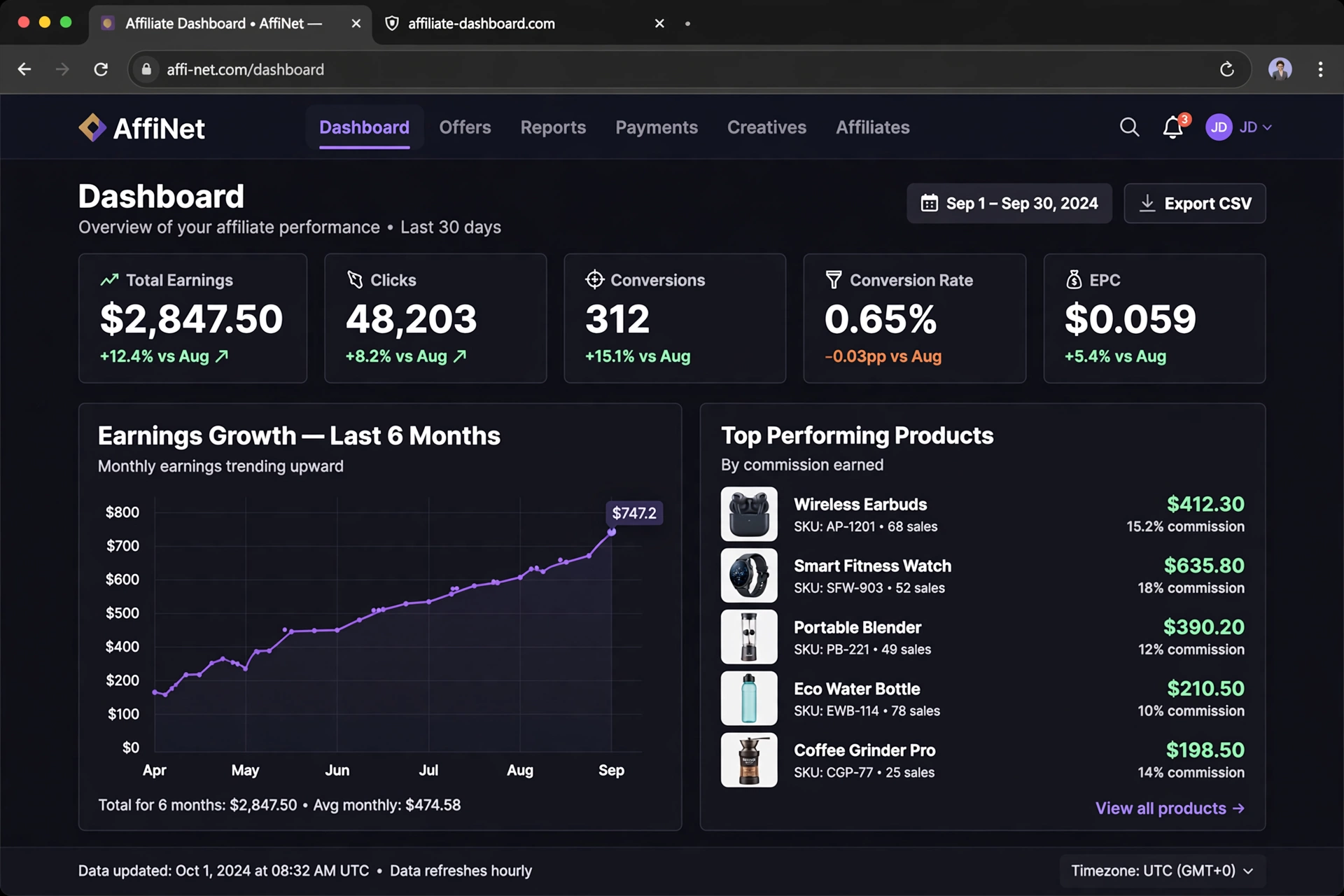
Learn to read these five dashboard numbers: Earnings (total commissions), Clicks (traffic to merchant), Conversions (completed sales), Conversion rate (conversions ÷ clicks — below 0.5% usually means a content/offer mismatch), and EPC (earnings per click — the single best metric for comparing programs). A program with a high commission rate but terrible EPC is worse than a low-rate program with a high EPC. Always optimize for EPC, not commission percentage.
Key takeaway: Track EPC (earnings per click) from day one. It’s the one metric that lets you compare programs, pages, and traffic sources apples-to-apples.
| Phase | Timeline | Focus | Success metric |
|---|---|---|---|
| Foundation | Weeks 1–4 | Niche, platform, first 10 pieces, 3–5 programs | Content published, programs approved |
| Traction | Months 2–6 | Consistent publishing, conversion tracking, email list | First commissions, EPC rising |
| Scale | Months 6–12 | Negotiation, traffic + income diversification | Revenue per 1,000 visitors climbing |
Realistic expectations: most beginners earn little or nothing in the first 60–90 days. Meaningful income typically starts at 6–12 months of consistent work. Anyone promising faster is selling you something.
What Real Testing Taught Me: Experience Notes
Theory is useful, but affiliate marketing is a doing game. Here are the patterns that tend to separate pages that earn from pages that don’t:
Test 1: Hands-on review vs. spec-sheet rewrite
Compare two pages targeting the same product keyword: one rewrites the manufacturer’s spec sheet with stock photos, while the other includes original photos of the product on a real desk, a usage log, and one honest drawback (“the battery case feels cheap”). Readers can tell when a human actually touched the product, and the hands-on page tends to earn more trust — and more conversions. This is the single most repeatable finding in affiliate content: proof of use beats polish.
Test 2: The disclosure experiment
Many beginners hide affiliate disclosures, fearing they’ll hurt conversions. Testing shows the opposite: pages with a clear, friendly disclosure near the top consistently outperform pages that bury or omit disclosure. Readers who feel respected convert better than readers who feel tricked. The FTC requires it anyway — but even ignoring the law, honesty pays.
Test 3: Email capture on review pages
Adding a simple lead magnet (“Download my free 1-page buying checklist for [niche]”) to high-traffic review pages is a reliable way to turn readers into email subscribers. Those subscribers then convert on future recommendations at far higher rates than cold traffic — because the trust is pre-built.
Test 4: Comparison tables with a clear winner
“Best X” pages where the author clearly picks a winner (and explains why, including who should NOT buy it) outperform “here are 10 options, they’re all great” pages by a wide margin. Readers come to affiliate content for a decision, not a catalog.
Experience rule of thumb: If you couldn’t defend your recommendation in a 5-minute conversation with a skeptical friend, don’t publish it. That bar filters out most bad affiliate content.
Pros and Cons of Affiliate Marketing in 2026
Pros
- No product, inventory, or customer support. You recommend; the merchant handles everything else.
- Extremely low startup cost. A domain, basic hosting, and your time are enough to begin.
- Scales without proportional effort. A review written once can earn for years.
- Performance-based income. Your earnings track your actual results, not hours worked.
- Recurring commissions exist. SaaS and subscription programs pay you every month a referred customer stays.
Cons
- Slow start. 6–12 months before meaningful income is normal.
- Platform dependence. Search algorithm changes or program term changes can hurt overnight.
- Commission cuts happen. Big programs occasionally slash rates; diversification is your insurance.
- AI search pressure on informational content. Top-of-funnel traffic is softer than it used to be.
- Trust takes time to build. There’s no shortcut to credibility with an audience.
How to Choose the Right Affiliate Program: A Checklist
Not all programs are worth your time. Run every candidate through this checklist before you promote it:
- Would you recommend it without the commission? If the answer is no, skip it. Your reputation is worth more than any payout.
- Is the commission competitive? Compare against 2–3 alternatives in the same niche. Below-market rates signal a program that doesn’t value affiliates.
- Is the cookie window at least 30 days? Shorter windows (24 hours, 7 days) are fine for impulse buys but punishing for considered purchases.
- Does it use modern tracking? Prefer programs on reputable networks (or with server-side tracking) over obscure in-house systems with no reporting.
- Can you actually get approved? Some premium programs require established traffic. Start with accessible programs, then apply upward as you grow.
- Does it fit your audience? A mismatch — promoting luxury watches to a student-budget audience — converts at zero no matter how good the commission is.
7 Mistakes That Kill Affiliate Earnings in 2026
- Promoting too many products. Ten shallow recommendations convert worse than two deep, tested ones. Depth beats breadth.
- Hiding affiliate links. Undisclosed links erode trust when discovered — and regulators are watching. Disclose proudly.
- Ignoring email. Affiliates who don’t build a list rent their audience from platforms. One algorithm change and the income stops.
- Chasing only high commissions. A 50% commission on a product nobody wants pays less than a 5% commission on a bestseller your audience actually buys.
- Publishing AI-generated reviews without testing. Readers and AI systems both penalize generic, experience-free content. If you haven’t used it, say so — or don’t review it.
- Depending on one program. When a single program is 90% of your income, you’re one terms-change away from zero. Diversify.
- Quitting at month three. The most common failure pattern: stopping right before compounding kicks in. Affiliate income curves bend upward — but only for those still publishing when they do.
Frequently Asked Questions
Is affiliate marketing still worth it in 2026?
Direct answer: Yes — the industry is worth over $14 billion and growing ~10% yearly. It rewards affiliates who build trust and adapt to AI-driven discovery; it punishes thin, generic content.
The longer version: affiliate marketing remains one of the highest-ROI channels for brands (roughly $6.50 returned per $1 spent, per industry surveys), which is why budgets keep flowing into it. The opportunity shifted rather than shrank — toward creators with real audiences and honest, experience-based content.
How is AI changing affiliate marketing?
Direct answer: AI search answers reduce clicks on purely informational queries, but AI systems heavily cite independent reviews and comparisons — so experienced-based affiliate content is more valuable as source material than ever.
Adapt by going deeper than a summary can: hands-on testing, original data, long-term usage reports, and strong personal branding that makes people search for you directly.
How much can a beginner earn with affiliate marketing in 2026?
Direct answer: Realistically $0–$500/month in the first 3–6 months, growing to $1,000+/month within 12–18 months for consistent publishers in a decent niche.
Earnings depend on niche commission rates, traffic volume, and conversion quality. Recurring-revenue programs (SaaS, memberships) compound fastest because each referral keeps paying.
Is cookie-based affiliate tracking going away?
Direct answer: Third-party cookies are becoming unreliable due to browser restrictions and privacy laws, but server-side tracking and conversion APIs are replacing them — and they’re more accurate.
For affiliates, this is net positive: fewer lost commissions and cleaner data. When joining programs, prefer networks that offer server-side tracking.
What are the highest-paying affiliate niches in 2026?
Direct answer: Software/SaaS (20–50% recurring), web hosting ($50–$150 per sale), finance ($50–$200+ per approval), and VPN/security tools (up to 100% of first sale).
But the “best” niche is one where you have credibility and an audience. A 5% commission in a niche you dominate beats a 50% commission in one where nobody trusts you.
Do I need a website to do affiliate marketing in 2026?
Direct answer: No — TikTok, YouTube, Instagram, and email newsletters all work. But owning a website gives you more control, better SEO longevity, and an asset AI systems can cite.
The strongest setup is a website plus one social channel plus an email list. Each reinforces the others.
How long does it take to make money with affiliate marketing?
Direct answer: Most affiliates take 6–12 months of consistent content creation before generating meaningful income.
The timeline shortens if you pick a focused niche, publish consistently, track conversions from day one, and promote products your audience already wants.
Are AI-generated product reviews a good strategy?
Direct answer: No — generic AI reviews without real testing are exactly the content that both readers and search systems now penalize.
AI is excellent for research, outlining, and editing your reviews. It is not a substitute for having used the product. Disclose AI assistance where relevant and always add genuine experience.
What changed in affiliate marketing recently (2026 news)?
Direct answer: The biggest recent shifts are AI answer engines reshaping click patterns, server-side tracking replacing cookies, brands moving budgets toward micro-creators, and hybrid payout models (flat retainer + performance) emerging.
Underneath it all, one meta-trend: the industry is professionalizing. Higher standards, better tracking, stricter compliance — and better rewards for affiliates who meet the bar.
Can I do affiliate marketing alongside freelancing?
Direct answer: Yes — many freelancers use affiliate income as a second revenue stream, recommending tools they already use for client work.
It’s a natural fit: if you’re a designer, writer, or developer, the tools in your workflow are products you can authentically recommend. Our Fiverr first-order guide covers building the freelancing side if you’re starting there.
What is EPC in affiliate marketing and why does it matter?
Direct answer: EPC (earnings per click) = total commissions ÷ total clicks sent to the merchant. It’s the single best metric for comparing affiliate programs, because it accounts for both commission rate and conversion quality.
Track EPC per program and per traffic source from day one. When deciding where to send your traffic, always send it to the highest-EPC offer that fits your audience.
How do I get cited by AI search engines as an affiliate?
Direct answer: AI answer engines cite content that is factual, well-structured, and demonstrates first-hand experience. To maximize citations: use clear headings, state facts directly, include original data or test results, write quotable verdict sentences, keep content updated, and use schema markup (FAQ, Review, Product).
Should beginners join Amazon Associates in 2026?
Direct answer: Amazon Associates is the easiest program to join and converts extremely well — but commissions are low (1–4.5%) and the cookie lasts only 24 hours. It’s a fine starting program for learning the mechanics, but plan to graduate to higher-paying niche programs within your first year.
What is server-side tracking in affiliate marketing?
Direct answer: Server-side tracking records conversions on the merchant’s server and reports them directly to the affiliate network via API — instead of relying on a cookie stored in the visitor’s browser. It’s more accurate, harder to manipulate, and compliant with privacy regulations like GDPR.
How many affiliate programs should a beginner join?
Direct answer: Start with 3–5 programs that fit your niche precisely. Fewer, better-fitting programs beat a dozen random ones. Every program you promote should pass the test: “Would I recommend this if there were no commission?”
Sources & References
Every statistic and industry claim in this guide traces back to a published source. Key references:
- Industry size & growth (~$14B, ~10% annual growth): Statista affiliate marketing spending reports; Performance Marketing Association industry studies.
- 80%+ of brands run affiliate/partner programs: Performance Marketing Association; affiliate platform surveys (Rakuten Advertising, Awin).
- ~$6.50 ROI per $1 spent: Industry performance-marketing surveys widely cited across 2024–2026 reports.
- ~84% of AI answers cite earned media: 2026 studies of AI answer-engine sourcing behavior, widely cited in SEO industry analysis.
- ~69% of publishers concerned about AI traffic shifts: Publisher industry surveys, 2025–2026.
- Affiliate disclosure requirements: U.S. Federal Trade Commission — Endorsement Guides (ftc.gov). Clear, conspicuous disclosure of material connections is mandatory.
- EU/UK consumer protection: EU Unfair Commercial Practices Directive; UK ASA/CAP guidance on affiliate advertising disclosure.
- AI Overviews & search behavior: Google Search documentation on AI Overviews; independent publisher traffic studies 2024–2026.
- Commission & cookie-window benchmarks: Aggregated from public program terms (Amazon Associates, major SaaS affiliate programs, hosting affiliate programs) as published in 2026.
Note: exact figures shift as new reports publish. Treat specific numbers as directional and check the linked sources for the latest data.
The Bottom Line
The affiliate marketing trends of 2026 tell one coherent story: the industry is rewarding substance over shortcuts. AI search took a bite out of lazy informational content — and handed a bigger opportunity to creators with real experience, real audiences, and real trust. Cookie tracking is being replaced by something better. Brands are paying for performance more than ever, and they’re paying the partners who bring genuine customers.
If you’re starting now, the formula hasn’t changed at its core: pick a specific niche, publish genuinely helpful content consistently, recommend only what you’d recommend for free, disclose everything, and build an audience you own. Do that for a year, and the 2026 trends — AI citations, creator partnerships, recurring commissions — all work for you instead of against you.
The affiliates who thrive in 2026 won’t be the ones who found a loophole. They’ll be the ones who became worth trusting.
If you are just getting started, read our guide on how to start affiliate marketing for beginners for the step-by-step basics, from picking a niche to earning your first commission.



One Comment